Electric vs Chemical Propulsion: What’s the Difference?
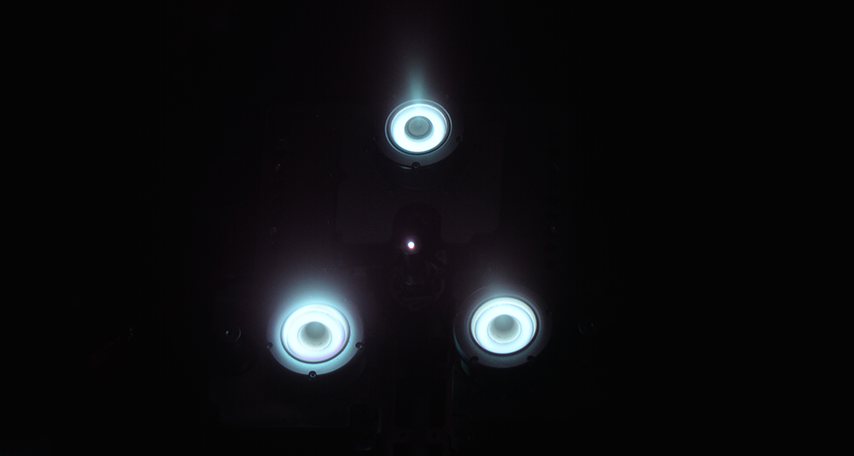
Electric and chemical propulsion are two of the main approaches used to move and control spacecraft. Both can perform orbital maneuvers, but they are optimized for fundamentally different performance regimes.
The key difference is simple: chemical propulsion provides high thrust and rapid acceleration, while electric propulsion uses propellant far more efficiently but produces much lower thrust.
This creates a fundamental spacecraft design trade-off involving thrust, propellant mass, electrical power and maneuver duration.
Understanding these differences is essential when selecting a propulsion system for applications ranging from LEO small satellites and constellations to GEO spacecraft and new in-orbit service missions.
The fundamental difference between chemical and electric propulsion is how they generate thrust.
Chemical propulsion releases energy through a chemical reaction and expels the resulting gases at high velocity. This allows the system to generate relatively high thrust, making it well suited for maneuvers that need to be completed quickly such as rapid orbital transfer or agile trajectory adjustments.
Electric propulsion works differently. Electrical power from the spacecraft is used to accelerate a propellant,often ionized, to much higher exhaust velocities.
The result is a very different trade-off:
The efficiency with which a propulsion system uses propellant is commonly described using specific impulse, or Isp. A higher specific impulse means that the spacecraft can achieve more change in velocity, often referred to as ΔV, with the same amount of propellant.
Typical spacecraft chemical propulsion systems operate in the range of roughly 200–450 seconds of specific impulse, while electric propulsion systems commonly operate above 1,000 seconds and can reach several thousand seconds, depending on the technology.
A useful analogy is to think of chemical propulsion as a sprinter and electric propulsion as a marathon runner. One delivers a powerful acceleration over a short period of time; the other applies a much smaller force but can do so efficiently over much longer periods.
At its most fundamental level, a spacecraft generates thrust by ejecting propellant in the opposite direction. For a given mission ΔV, the amount of propellant required depends largely on how fast that propellant can be expelled. A propulsion system can broadly either:
Chemical propulsion is limited by the energy available from its chemical reaction. Electric propulsion can use electrical energy generated by the spacecraft to accelerate its propellant to much higher exhaust velocities.
This is why electric propulsion can dramatically reduce the amount of propellant required for missions involving significant cumulative ΔV.
For spacecraft designers, this can translate into:
However, reducing propellant mass does not mean that electric propulsion comes without system-level constraints.
Electric and chemical propulsion represent two fundamentally different approaches to spacecraft design. While chemical propulsion can deliver high thrust without requiring large amounts of electrical power, achieving large ΔV maneuvers generally requires a larger amount of propellant. Electric propulsion takes the opposite approach: it can dramatically reduce propellant requirements but relies on electrical power and typically requires longer maneuver durations.
The trade-off is therefore not simply between high thrust and high efficiency. Spacecraft designers must balance several interconnected parameters, including available electrical power, solar array and power subsystem sizing, propellant mass and volume, required ΔV, maneuver duration, mission timeline and operational flexibility.
For a given electric propulsion technology and operating regime, increasing the power available to the propulsion system can enable higher thrust, shorter maneuver times, or a combination of both. The benefits of reduced propellant mass must therefore be assessed at the spacecraft level, considering how propulsion interacts with the power subsystem, payload allocation and overall mission architecture.
This shift is particularly relevant for modern, mass-constrained spacecraft, where propulsion efficiency can directly influence payload capacity, mission lifetime and operational flexibility.
Rather than one technology simply replacing the other, the choice between chemical and electric propulsion ultimately depends on the mission's priorities and the required balance between thrust, propellant efficiency, electrical power and maneuver time.
There is no universally better propulsion technology. The right choice depends on what the mission is trying to optimize.
Chemical propulsion is generally preferred when the spacecraft needs:
Electric propulsion is generally preferred when the mission prioritizes:
In some missions, the best solution is not electric or chemical propulsion, but a combination of both. A hybrid architecture can use chemical propulsion for high-thrust or time-critical maneuvers while relying on electric propulsion for efficient long-duration operations.
Electric propulsion is not a single technology. It includes Hall Effect thrusters, gridded ion engines and several other approaches, each offering different trade-offs between thrust, specific impulse, electrical power consumption and operational lifetime.
Hall Effect thrusters are among the most mature and widely deployed electric propulsion technologies.
Hall Effect thrusters occupy an important position within the electric propulsion landscape, combining high propellant efficiency with relatively high thrust compared with many other electric propulsion technologies.
This makes them particularly relevant for applications requiring a balance between maneuver duration, propellant efficiency and available electrical power.
Hall Effect thrusters are used for applications ranging from LEO satellite maneuvering and constellation operations to GEO orbit raising, station keeping and deep-space missions.
The future of spacecraft propulsion is about optimization
Electric and chemical propulsion are not simply competing technologies. They represent different approaches to solving the same engineering problem.
Chemical propulsion prioritizes thrust and maneuver responsiveness. Electric propulsion prioritizes propellant efficiency and can fundamentally change spacecraft mass allocation and mission architecture.
As satellites become more capable and mission requirements become increasingly diverse, propulsion system selection is becoming a broader system-level optimization problem.
For missions where propellant mass and long-term maneuvering capability are critical, electric propulsion can provide a major architectural advantage. Where high acceleration and rapid trajectory changes are required, chemical propulsion remains essential.
Choosing the right propulsion technology ultimately means finding the right balance between thrust, ΔV, propellant mass, electrical power and mission time.